

Key Takeaways
Used parts can be a sensible way to repair or refresh a Suzuki S-Cross, but the right component starts with accurate vehicle information. A little checking before purchase can prevent an expensive mismatch.
- Confirm the generation, model year, engine, transmission, and drivetrain before searching.
- Compare the VIN and original part number with the seller’s listing.
- Ask about donor-vehicle mileage, testing, damage, warranty, and returns.
- Include shipping, installation, fluids, seals, and possible refurbishment in the budget.
- Record the replacement part and related work for future servicing.
Understanding which Suzuki S-Cross used parts you need
A used component is only useful if it matches the vehicle it is meant to repair. Suzuki S-Cross specifications can vary by year, market, trim, engine, and drivetrain, while a photograph may not reveal those differences. Start with the vehicle details and the failed part, then narrow the search rather than buying the first listing that appears.
Identifying the correct generation and model year
Begin with the registration documents, service records, and the vehicle identification plate. The model name alone may not identify the correct component, especially when a listing uses both “S-Cross” and “SX4 S-Cross.” Check the production year as well as the date the vehicle was first registered, since those dates are not always the same.
Body changes, revised wiring, and updated trim can make otherwise similar vehicles incompatible. If the part is visible, compare mounting points, connectors, shape, and finish with the original before placing an order.
Matching engine, transmission, and drivetrain specifications
Engine size is only one part of the match. Note the fuel type, engine code if available, transmission type, drive layout, and whether the vehicle has two-wheel or four-wheel drive. These details matter particularly for engines, gearboxes, driveshafts, differentials, control modules, and cooling components.
A seller should be able to tell you which vehicle the part came from. If the listing provides only a broad model description and no useful specification, ask for more information or treat it as a lead rather than a confirmed match.
Using the VIN and original part number
The VIN gives a parts specialist a much firmer starting point than a model name. Photograph the VIN and the label on the old component, making sure every character is readable. An original part number, casting mark, or module number can then be compared with the number supplied by the seller.
The original number matters even when the old part has failed. It can reveal the exact design fitted to the vehicle and help identify later replacement numbers. Keep the damaged component until the replacement has arrived and been checked.
Distinguishing replacement parts from accessories
Replacement parts restore a failed or damaged vehicle function; accessories add convenience, protection, or appearance. A roof accessory, trim piece, floor mat, or styling item may be advertised alongside mechanical components but will usually follow different fitment rules.
Read the listing title and description carefully. Confirm whether brackets, wiring, fasteners, sensors, or other supporting pieces are included, since a component that looks complete may require parts from the original vehicle.
Where to buy Suzuki S-Cross used parts
The best source depends on the part, its value, and how much evidence you need before buying. A dismantler may provide donor-vehicle details, while a marketplace can offer a wider choice but requires more careful seller evaluation. Local networks can be useful for bulky items, although they may provide less formal protection.
Salvage yards and vehicle dismantlers
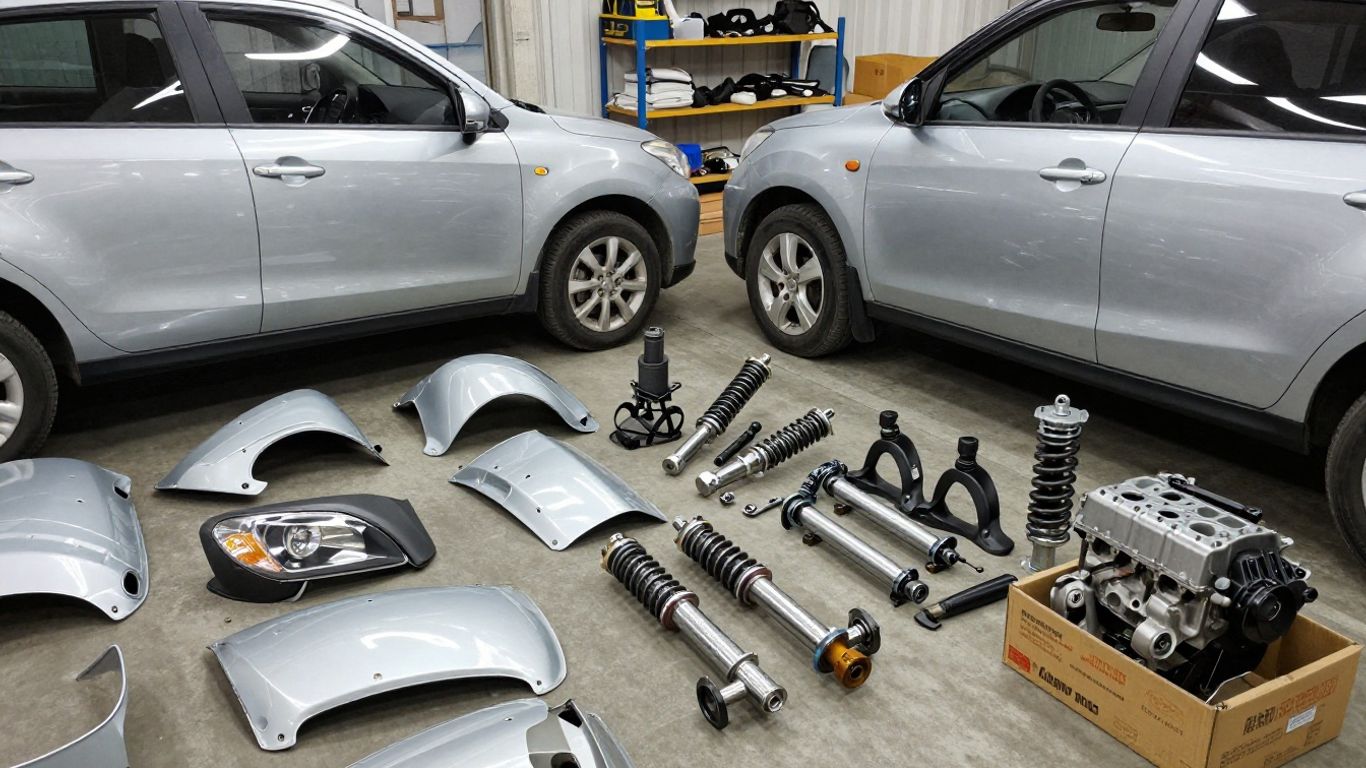
Salvage yards and dismantlers often identify components by the donor vehicle rather than by a generic model description. Ask for the donor’s year, engine, transmission, mileage, damage location, and whether the part was tested before removal. For body parts, also ask whether the vehicle had impact damage near the component you need.
A dismantler may be able to supply related hardware or confirm which parts were removed together. That can be especially helpful for a sensor, bracket, loom, or interior panel whose small attachments are easy to overlook.
Online used-parts marketplaces
Online marketplaces make comparison easier, but the volume of listings also creates room for vague or inaccurate descriptions. Filter by year and specification where possible, then read the full description instead of relying on the headline. Review photographs for labels, connector shapes, mounting points, and visible damage.
Before paying, ask how the part will be packed and what happens if it does not match the listing. Screenshots of the listing and messages can provide a useful record if a dispute later arises.
Specialist Suzuki breakers and recyclers
A specialist recycler may have deeper knowledge of recurring model variations and may keep donor-vehicle records. Ask whether the part has been inspected, tested, cleaned, or reconditioned, and what exactly the warranty covers. “Tested” should be explained in practical terms rather than treated as a blanket assurance.
For a high-value component, a specialist’s ability to answer specific fitment questions can be worth more than a small difference in the advertised price. It also reduces the chance of receiving a part that is technically from an S-Cross but not from the same specification.
Private sellers and local automotive networks
Private sellers can be a reasonable source for trim, wheels, interior pieces, and other visible components. They may also have useful maintenance history if the part came from their own vehicle. However, condition, returns, and compatibility are usually less formal than with a commercial dismantler.
Inspect the part in person when practical, particularly if it is heavy or expensive to ship. Agree in writing on the price, included items, collection arrangements, and any known defects before handing over payment.
Checking compatibility before you buy
Compatibility is more than a similar appearance. Electrical components can share a housing while using different software or connectors, and mechanical parts can differ in ratios, mounting points, or sensor arrangements. Treat fitment as something to verify with evidence, not something to assume from a photograph.
Comparing OEM part numbers and supersessions
Compare the number on the original component with the number in the listing. Manufacturers sometimes replace an earlier number with a superseding number, so an exact mismatch is not automatically a problem, but it should be confirmed through a reliable parts catalog or specialist.
Ask the seller to photograph the complete label rather than typing the number from memory. Also check whether the number identifies a bare component, a complete assembly, or a software-specific control unit.
Confirming fitment across trim levels
Trim level can affect lighting, audio equipment, seats, sensors, wheels, suspension, and interior switches. Ask whether the donor vehicle had the same equipment, but do not assume that matching trim names guarantee identical parts across different years or markets.
For body and interior pieces, compare color codes and upholstery codes where available. For electronic items, check connector count and part number as well as the visible shape.
Verifying left-hand and right-hand components
Many Suzuki S-Cross used parts are side-specific. Headlights, mirrors, doors, window regulators, steering components, brake parts, and suspension pieces may differ between the left and right sides, even when they look nearly symmetrical.
Use the vehicle’s driving position and the seller’s stated side consistently. When terminology is unclear, request a photograph from the front of the component and confirm whether the seller means the vehicle’s left or the viewer’s left.
Checking regional and import-market differences
Vehicles sold in different markets can have different lighting, emissions equipment, safety systems, wiring, and steering positions. An imported S-Cross may therefore need a component that is unusual or unavailable under the local catalog description.
Give the seller the market of origin and the VIN when asking for confirmation. This extra detail is particularly useful for lamps, modules, dashboards, mirrors, and engine-management components.
Assessing the condition and quality of used parts
Used does not mean unusable, but condition varies widely. A clean photograph can hide worn seals, bent mounting points, water damage, or missing hardware. Assess the part’s history and likely remaining service life alongside its price.
Reviewing mileage, service history, and donor-vehicle details
Mileage is a helpful clue for engines, transmissions, steering parts, suspension, and electronic wear items, but it is not a complete condition report. Ask whether the donor vehicle was running, why it was dismantled, and whether the component was removed before or after an accident.
Service records can provide more context than mileage alone. A higher-mileage part with regular maintenance may be a better prospect than a low-mileage component with unknown storage conditions or impact history.
Inspecting body panels, interior parts, and electrical components
For body panels, inspect edges, seams, mounting tabs, and evidence of repainting. Interior pieces should be checked for broken clips, sun damage, stains, and missing trim. Electrical parts need particular care: look for green corrosion, bent pins, water marks, cut wiring, and cracked housings.
Request clear photographs of every connector and fixing point. If the part is sold as working, ask what test was performed and whether the seller can provide a short-start or bench-test video when appropriate.
Evaluating engines, transmissions, and suspension assemblies
Large mechanical assemblies deserve a written condition report. For an engine, ask about compression testing, oil contamination, coolant contamination, leaks, included accessories, and the reason for removal. For a transmission, ask about noise, shifting behavior, fluid condition, and whether the unit includes sensors, mounts, or a torque converter where relevant.
Suspension assemblies should be checked for bent arms, damaged threads, leaking dampers, seized adjusters, and worn bushings. A complete visual inspection does not replace professional testing, but it can expose obvious risks before money and labor are committed.
Recognizing signs of corrosion, impact damage, and wear
Surface dirt is usually manageable; structural distortion and deep corrosion are different concerns. Check welds, seams, threaded holes, brackets, and mating surfaces. Fresh paint in one small area may conceal an earlier repair, while mismatched gaps can indicate impact damage.
Ask how the part was stored after removal. Moisture, poor packaging, and long outdoor exposure can harm electrical connectors, brake components, rubber seals, and machined surfaces even when the donor vehicle was in good condition.
Buying high-value Suzuki S-Cross components
High-value parts deserve a slower buying process because the purchase price is only one part of the risk. Installation labor, fluids, calibration, return freight, and downtime can quickly exceed the original saving. Obtain the specification and warranty terms in writing before ordering.
What to check when purchasing a used engine
Confirm the engine code, included ancillaries, mileage, compression or running-test information, and the reason for removal. Clarify whether the long block, cylinder head, turbocharger, injectors, sensors, manifolds, starter, and alternator are included or must be transferred from the old engine.
Plan for new filters, fluids, seals, and any one-time-use fasteners recommended for the installation. A used engine can be a practical option, but the workshop should inspect it before fitting rather than treating the seller’s description as a complete diagnosis.
How to evaluate a used transmission
Match the transmission code and drivetrain, not simply the vehicle badge. Ask about mileage, fluid leaks, storage, shaft play, noises, and whether it was removed from a running vehicle. Automatic and automated systems may also require related electronics, programming, or calibration after installation.
Check what arrives in the crate. A transmission that appears complete may not include mounts, sensors, linkages, a clutch assembly, or other vehicle-specific hardware, and these omissions can change the real cost substantially.
Choosing reliable turbo, fuel, and cooling-system parts
Turbochargers, fuel-system components, radiators, pumps, hoses, and thermostats should be matched by engine specification and part number. Ask about shaft play, contamination, seized fittings, pressure testing, and whether the part was removed from a running vehicle.
Rubber and plastic components deserve extra scrutiny because age can matter as much as mileage. If a used hose, seal, or thermostat is inexpensive and difficult to verify, compare its fitted cost with a new equivalent before deciding.
Comparing complete assemblies with individual components
A complete assembly may save time when several related pieces are damaged or missing. An individual component may cost less and make more sense when the surrounding parts are known to be healthy. Compare both options on condition, included hardware, labor, and warranty rather than purchase price alone.
Use a simple side-by-side quote for expensive repairs. The cheapest bare component is not necessarily the least expensive route if it requires extra diagnosis, cleaning, adaptation, or a second order for missing parts.
Calculating the real cost of used parts
A used part’s advertised price is the beginning of the calculation. Shipping, packaging, inspection, installation, and possible return costs can materially change the result. Write down the full estimate before comparing used, refurbished, and new options.
Comparing part price with shipping and handling fees
Heavy components can be inexpensive to list but costly to transport. Ask for the packed weight, delivery timeframe, insurance, and whether the quote includes residential or remote-area surcharges. For body panels and glass, confirm how damage in transit will be handled.
Compare delivered prices rather than headline prices. A slightly more expensive local part may be the better choice if it can be inspected first and collected without specialist freight.
Factoring in testing, refurbishment, and installation
Add diagnostic time, bench testing, cleaning, machining, programming, fluid replacement, and workshop labor to the estimate. Some parts also require a follow-up alignment, calibration, or road test. These costs are easy to overlook when the component itself seems affordable.
Ask the technician which old parts should be replaced while access is available. Preventive work can cost less than removing the same assembly again after a neglected seal or worn mount causes trouble.
Understanding warranties, returns, and core charges
Read the warranty period, exclusions, claim process, and labor coverage before paying. Some warranties cover only the replacement component, while others require professional installation or proof of related maintenance. A core charge may also apply when the old component must be returned.
Keep invoices, photographs, test results, and delivery records. If the part arrives damaged or differs from the listing, document the condition immediately and contact the seller before installation.
Deciding when a new aftermarket part is better value
A new aftermarket component may be preferable for wear items, seals, filters, belts, hoses, and inexpensive sensors when its quality and warranty are clear. A used original part can still be attractive for body panels, trim, modules, or uncommon assemblies that are costly or difficult to source new.
Make the comparison at the vehicle level. Reliability, installation access, return protection, and the consequences of another failure may matter more than the initial difference in price.
Installing and maintaining replacement components
Good installation protects the money already spent on the part. Before work begins, confirm the part number, inspect the component, and compare it with the old one. This is the point to resolve a mismatch, not after the vehicle has been dismantled.
Preparing for professional or DIY installation
Read the relevant service information and gather the correct tools before starting. DIY work should be limited to jobs within your experience, with safe lifting equipment and a clear plan for handling fluids, electrical systems, and heavy assemblies.
For professional work, give the technician the seller’s condition report and warranty requirements. Ask what checks will be performed before fitting and what additional parts or calibration the job may require.
Replacing seals, fluids, and one-time-use hardware
A replacement assembly may be sound while its old seals, gaskets, fluids, or fasteners are not. Replace these items where the service procedure calls for it, and use the specified fluid rather than choosing by appearance or price. Clean mating surfaces and protect open lines from dirt during the job.
Do not reuse single-use hardware simply because it appears undamaged. The cost of the correct fastener is small compared with the risk of a loose mount, leak, or premature failure.
Testing the vehicle after installation
Start with a visual inspection for loose connectors, leaks, trapped wiring, unusual gaps, and missing covers. Then follow the appropriate diagnostic, fluid-level, warning-light, and road-test procedures. Begin slowly and stop if there is abnormal noise, vibration, smell, temperature, or warning behavior.
A post-installation scan may be needed for electronic components, while suspension or steering work may require an alignment. Confirm that the original fault has been resolved rather than assuming that the absence of a warning light proves everything is correct.
Keeping records for future maintenance and resale
Record the date, mileage, supplier, part number, donor details, warranty, and installation work. Keep photographs of labels and receipts with the vehicle’s service history. These records make future compatibility checks easier and provide useful evidence if a warranty issue develops.
When it is time to sell the vehicle, clear documentation helps explain the repair without overstating the condition of the used component. If you need help with sourcing or a quote, you can contact Just Suzuki and keep the vehicle details ready for the conversation.
Conclusion
Finding Suzuki S-Cross used parts is mostly a matter of disciplined checking: identify the vehicle precisely, verify the part number, investigate condition, and calculate the complete fitted cost. When those steps are followed, a used component can be a sensible repair choice rather than a gamble.